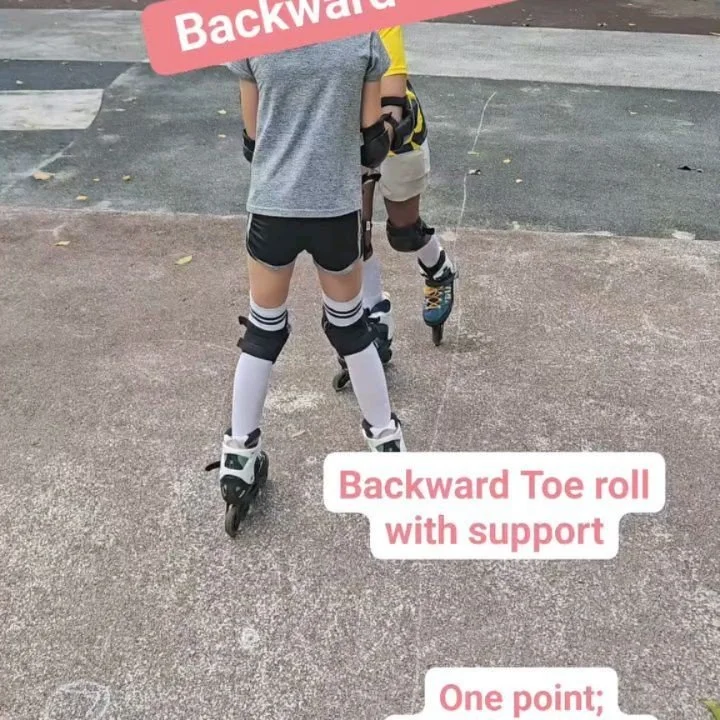
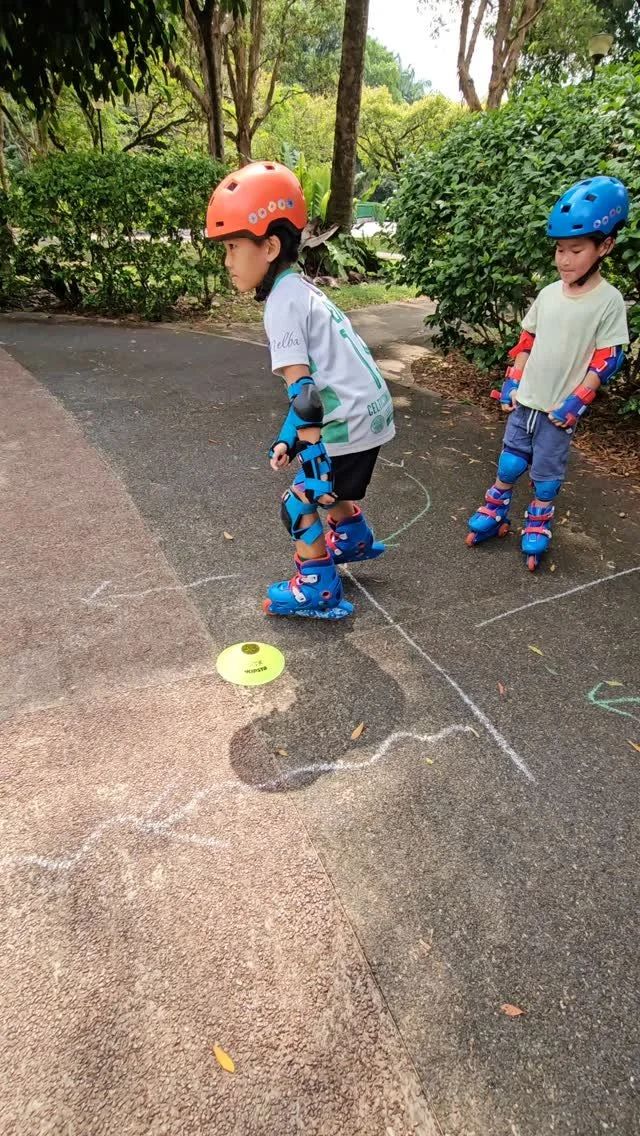
Common challenge, Navigating downslopes

Dear Members and Parents
Let's talk about something many kids find tricky when they start skating: going downhill! It's totally normal for them to feel a little nervous or have trouble with it.

I've put together some tips to help your children learn how to glide down slopes safely, keep their speed under control, and handle things like drain covers and curbs. My goal is to give you some clear ideas so you can help them become more confident and skilled skaters. I hope this helps!"

Downslope Skill Progression

  1. Gliding on a mild slope

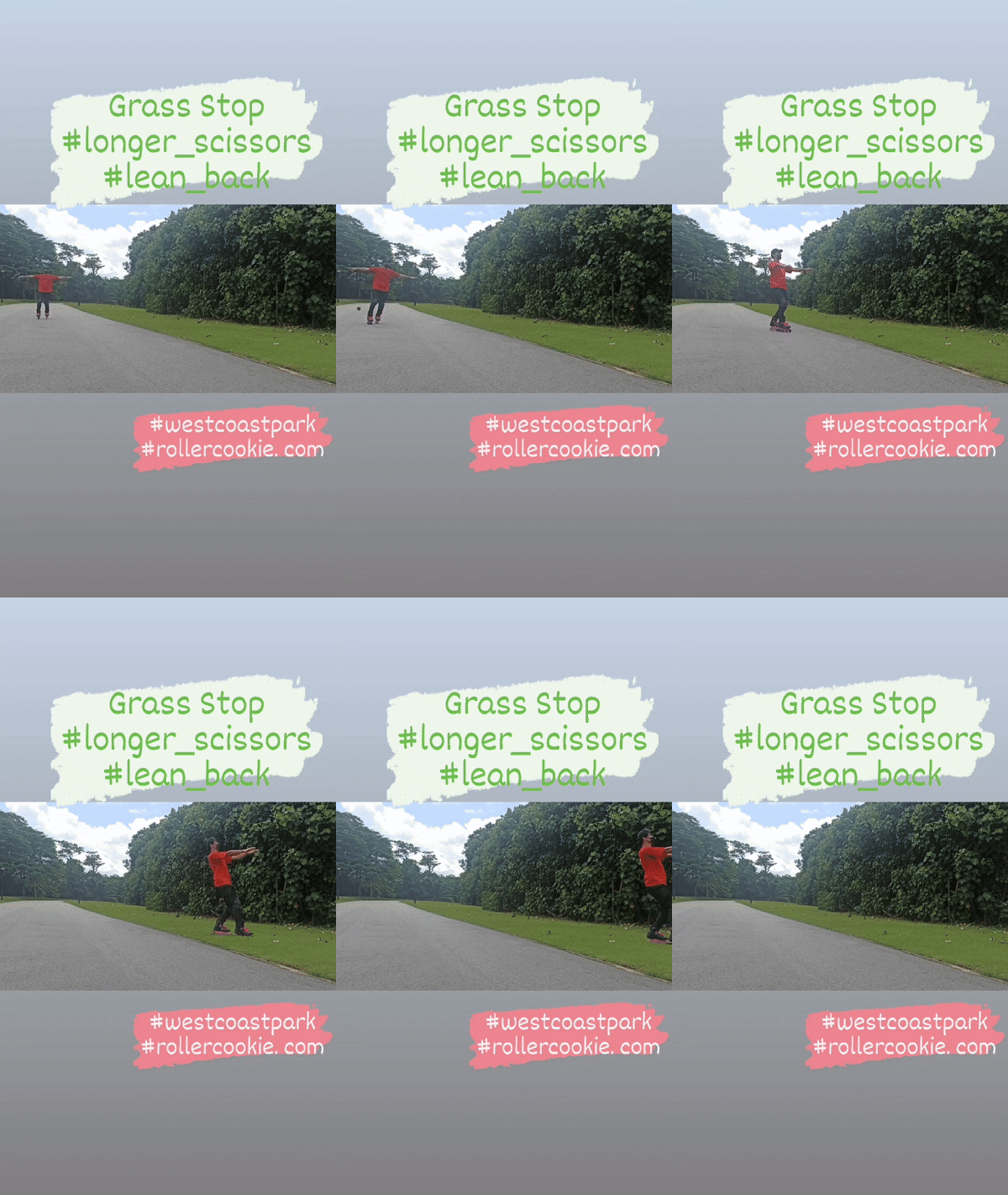
  2. Grass Stop (critical safety skill): If a student has a heel stop but lacks the confidence for high-speed braking, they must master the Grass Stop on a gentle slope first. This provides a "safety exit" while they build confidence.

    Grass stop?? 🎥(video clip)

    👀 Masters of Grass Stop 🎥(video clip)

    • Anyone can fall, but grass stop helps prevent secondary injury

    • Beginners often freeze or fall backward when speed increases

    • Teaching them to step into grass is safer than losing balance backward

      👉 Refer to the linked article of Grass Stop

  3. Turning to control speed: Control comes from changing momentum. Coaches must teach students to turn across the slope and perform U-turns. By changing direction against their current momentum, students naturally bleed off speed.

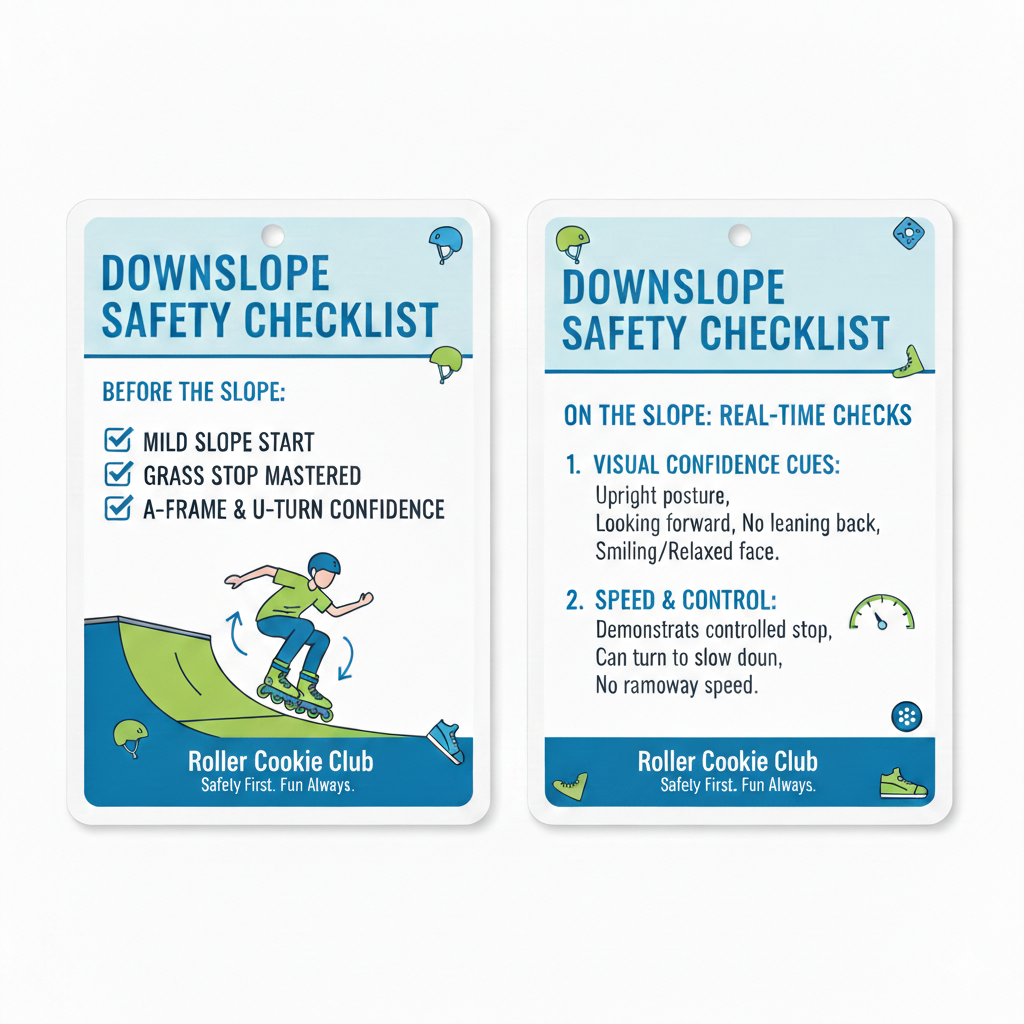
  4. Managing mild to steeper slopes: Before moving a student from a mild slope to a steep slope, they must demonstrate:

    • Consistent Heel Stops 🎥(video clip). and Grass Stops.

    • Confident A-Frame Turns (both Left and Right).

    • A full U-Turn back up the hill to a complete stop.

  5. Urban skating: Our objective is to transition students from "surviving" a hill to "enjoying" it. Once the basics are mastered, we can introduce advanced techniques similar to skiing:

    When our skaters feel safe, they have fun. Let's ensure every student feels empowered to explore the park and handle different terrain with total confidence.

    • Controlled skating around the park

    • Exploring slopes of different gradients with intention and supervision

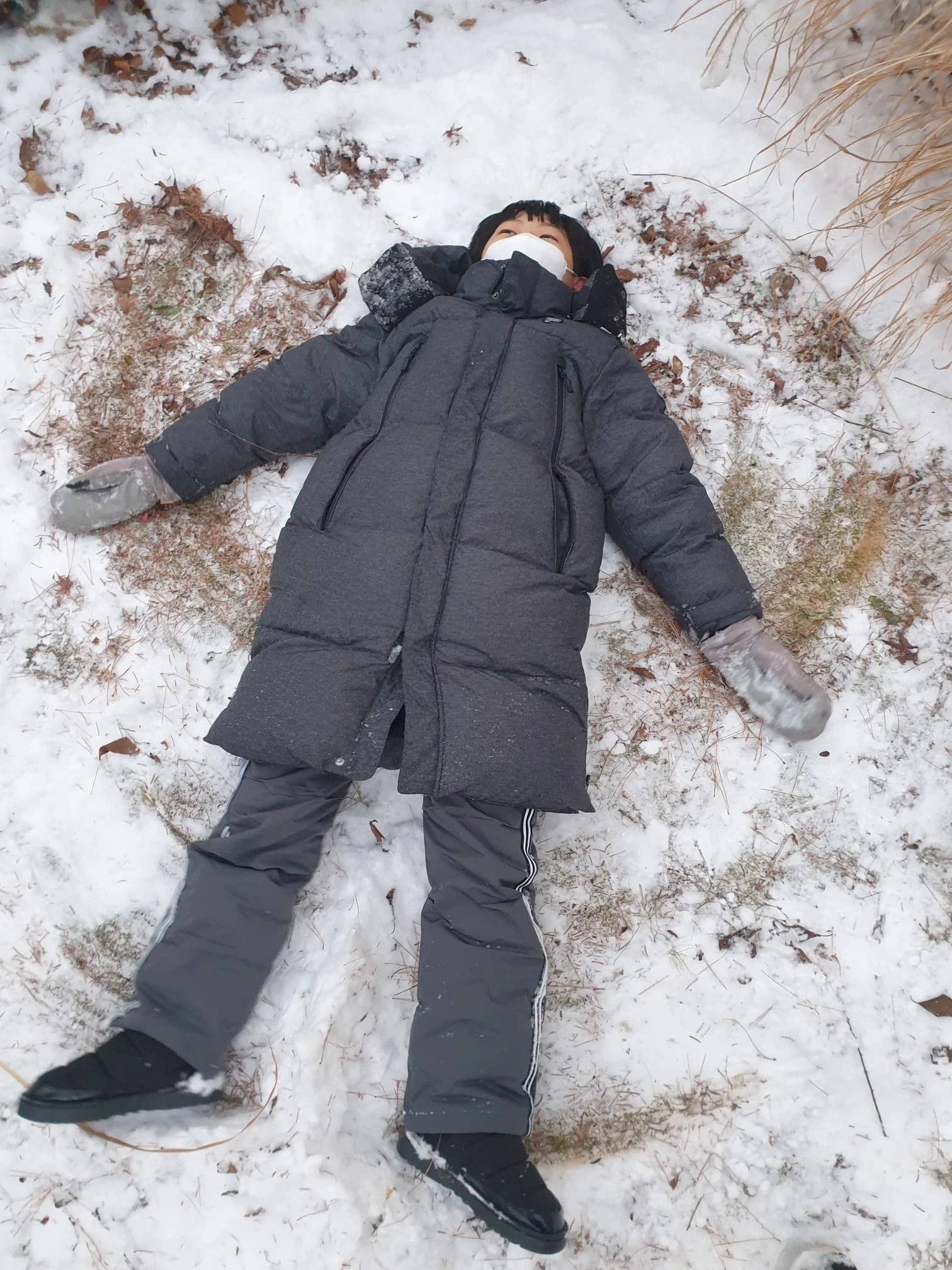
❄️ A Magic Gift from the Sky: The Story of the First Snow

Have you ever wondered what it’s like to live in a place where the air turns into ice? In Singapore, we have beautiful sunshine all year, but I want to take you on a journey to my childhood home during a special time called Soseol—the season of the "First Snow."

🎁 The Big Morning Surprise

Imagine waking up and looking out your window. Usually, you see brown dirt, green grass, and gray roads. But today, everything is gone! Overnight, a secret artist has repainted the entire world in sparkling, pure white.

  • The "Mute" Button: When it snows, the world goes quiet. It’s like someone turned the volume down to zero. No cars honking, no loud voices—just a peaceful, soft silence.

  • A Sparkling Storybook: Every tree branch and rooftop looks like it’s covered in diamond dust. The air glitters, and you feel like you’ve stepped right into a fairy tale.

  • The Tingly Feeling: When you run outside, the cold air makes your nose tingle! Putting your hand in the snow feels amazing—it’s soft like powder, but you can squeeze it together to make a snowball. It is the sky’s way of saying, "Come out and play!"

🌴 Why is it so special?

Since you see the blue ocean and green trees every day, imagine if one morning the beach was covered in bright pink sand. You would be so excited, right? That is how the first snow feels to us. It’s a magical change that reminds us how beautiful the world can be.

👴 The Lesson of the "Wise Old Trees"

But the first snow isn't just about playing. It also brings a very important message, just like the story of Scrooge in A Christmas Carol.

As the snow falls, the weather gets very, very cold. This is nature’s way of telling us to "Stay alert and be humble."

  1. Nature is Changing: In the summer, trees are tall, green, and strong. But in winter, they lose their leaves and look like thin, wise old men. This reminds us that we won't always be "hot" and "strong" like summer. We all grow older, and sometimes we feel weak or tired.

  2. Open Your Heart: When it’s freezing outside, life is very hard for people who don't have warm homes or thick coats. Winter tells us: "Don't be stuck up or selfish!" Just like Scrooge learned to be kind, the first snow reminds us to look around. It's a time to give a helping hand to those who are struggling and to take care of our neighbors.

✨ The True Magic

The first snow is a beautiful gift, but the real magic happens inside us. It’s a season that turns our hearts into warm, caring places. It teaches us to be brave in the cold and kind to everyone we meet.

Would you like to visit a winter country during the holidays and feel the magic of the first snow for yourself?


❄️ Origin of Soseol (小雪)

Soseol is the 20th of the 24 solar terms in the traditional East Asian lunisolar calendar. The name itself directly reveals its origin and meaning:

  • Etymology: The name Soseol is a combination of two Chinese characters:

    • 小 (So): Meaning 'small' or 'little'.

    • 雪 (Seol): Meaning 'snow'.

  • Meaning: The term literally translates to "Little Snow". It was named this because this period marks the beginning of the season when the first light snow (or little snow) starts to fall, and thin ice begins to form, bringing the true feeling of winter.

🗓️ Timing and Significance

  • Timing: Soseol typically falls around November 22nd or 23rd in the Gregorian calendar. It occurs roughly 15 days after Ip-dong (立冬, Beginning of Winter) and 15 days before Dae-seol (大雪, Heavy Snow).

  • Significance: It signifies that although the amount of snow from the sky is not large, it is the time to experience the first snow of the year and for the cold to gradually intensify, urging people to prepare for the deep winter ahead.

A fun icebreaker talk with new students. One example how we carry on first lesson.

Safety First, Fun Always

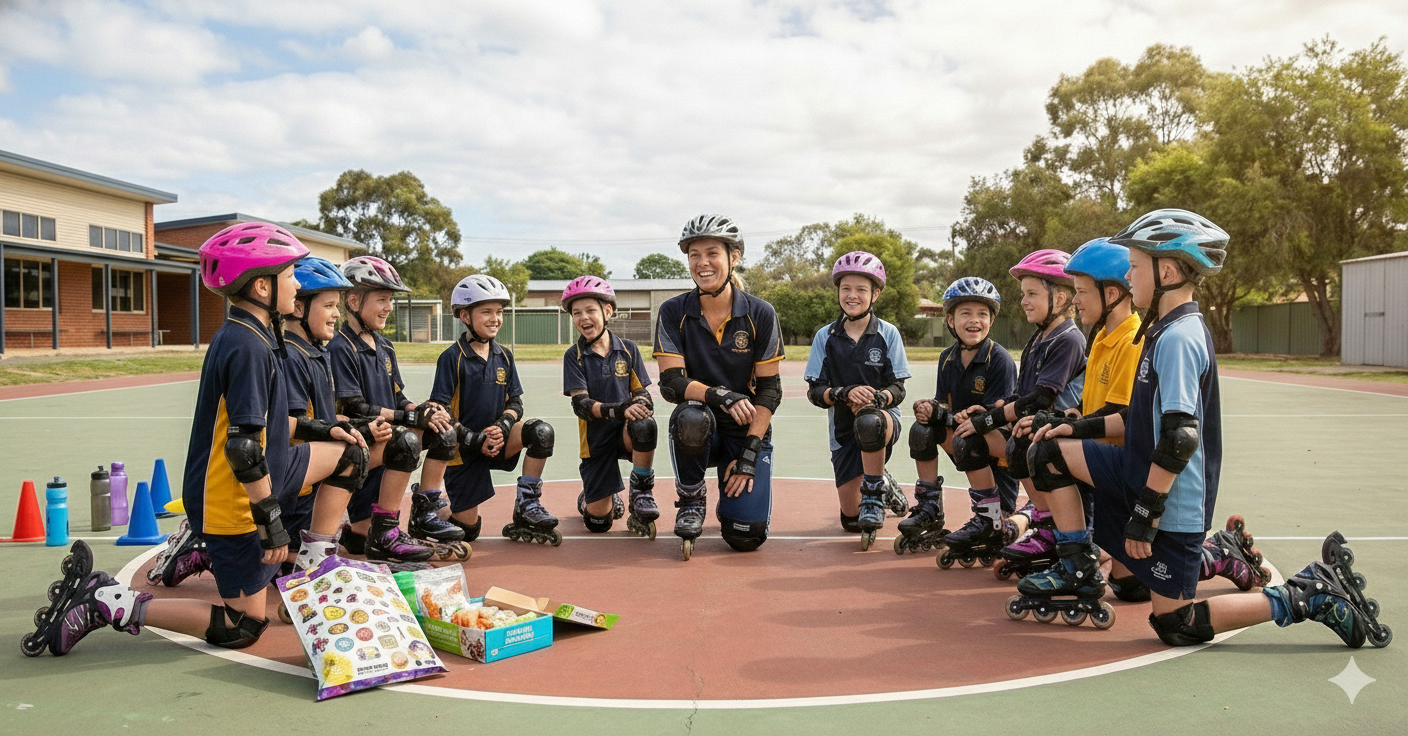
New inline skaters are excited but also nervous about falling backward. As the coaches, our first day needs to validate students’ fears while immediately giving them control through proper technique. The coaches should maintain an air of calm authority—strict about safety rules and technique, but warm and enthusiastic about the sport.

Here is an approach we used to apply, including a fun icebreaker talk. Here you go.

The Flow of the First Session

  1. Welcome & Icebreaker Talk (10 min): Set the tone. (See example below).

  2. Gear Check & "The Ready Stance" (10 min): The most serious, crucial part.

  3. Safety Falling & Standing Up Drill (15 min): Address the fear of falling head-on.

  4. Movement Fundamentals: "The V-Push" (10 min): Start moving slowly.

"Welcome, everyone! Give yourselves a huge clap for being brave enough to try inline skating. That takes real courage. I’m Coach Moon and this is Coach Sun.

We are so excited to teach you how to fly on wheels.

Now, I'm going to tell you a secret: Every single coach here—and every pro skater you see on TV—has fallen hundreds of times. Falling is part of learning. But the goal of today is not to prevent you from falling; it's to teach you how to fall safely, and more importantly, how not to fall backward.


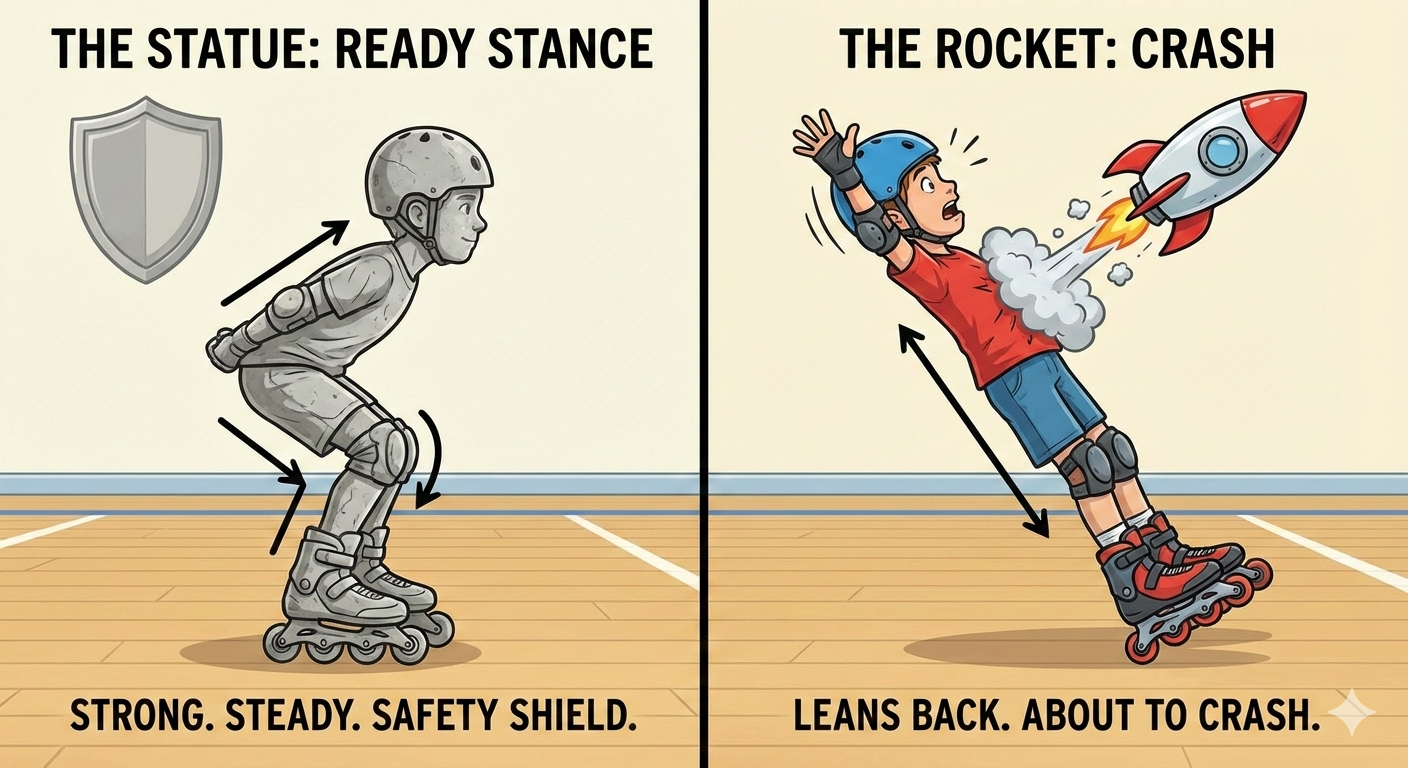
Rule #1: Be a Statue, Not a Rocket

Look at me. We're going to use two images to keep you safe: The Statue and The Rocket.

The Statue: A statue stands strong, right? No matter what the weather, it's steady. When you're on skates, your Ready Stance is your statue:

  • Knees bent. (Bend your knees right now and feel the power!)

  • Shins over your toes.

  • Back straight but leaning slightly forward.

If you feel wobbly, what do you do? Bend the knees and make the Statue. This is your safety shield.

The Rocket: What does a rocket do when it's taking off? It leans back a little, right? But if you lean backward on skates, you become a rocket that's about to crash. Your brain will tell you to stand up straight when you feel wobbly, but that’s the worst thing you can do!

The Golden Rule: If you feel like you are falling, bend your knees more and lean forward! You can always catch yourself on your hands or knees, but you never want to fall backward onto your tailbone.

So, for the rest of the day, when a coach says 'Show me your Statue!', what do you do? (Wait for them to respond or demonstrate bending their knees). And when you feel like you're falling, which way do you lean? Forward!


Rule #2: Gear Up is Power Up

"Before we even think about moving, let's talk about our gear. This isn't just safety equipment; it's your super armor.

  • Helmet: Protects your amazing brain.

  • Wrist Guards: The first thing you'll put down when you fall. These are your shock absorbers.

  • Elbow/Knee Pads: These let you practice falling safely without getting scraped.

The Strict Part: If your helmet is unbuckled, or if you take your wrist guards off, you are sitting down immediately. No exceptions. This is the one rule we are Statues about!

Let’s get our super armor on and learn how to master the Statue!"


Immediate Drills to Build Confidence

After the above practice, transition to these activities to immediately address students’ fear of falling backward:

A. The Safety Squat & Fall Drill (Crucial!)

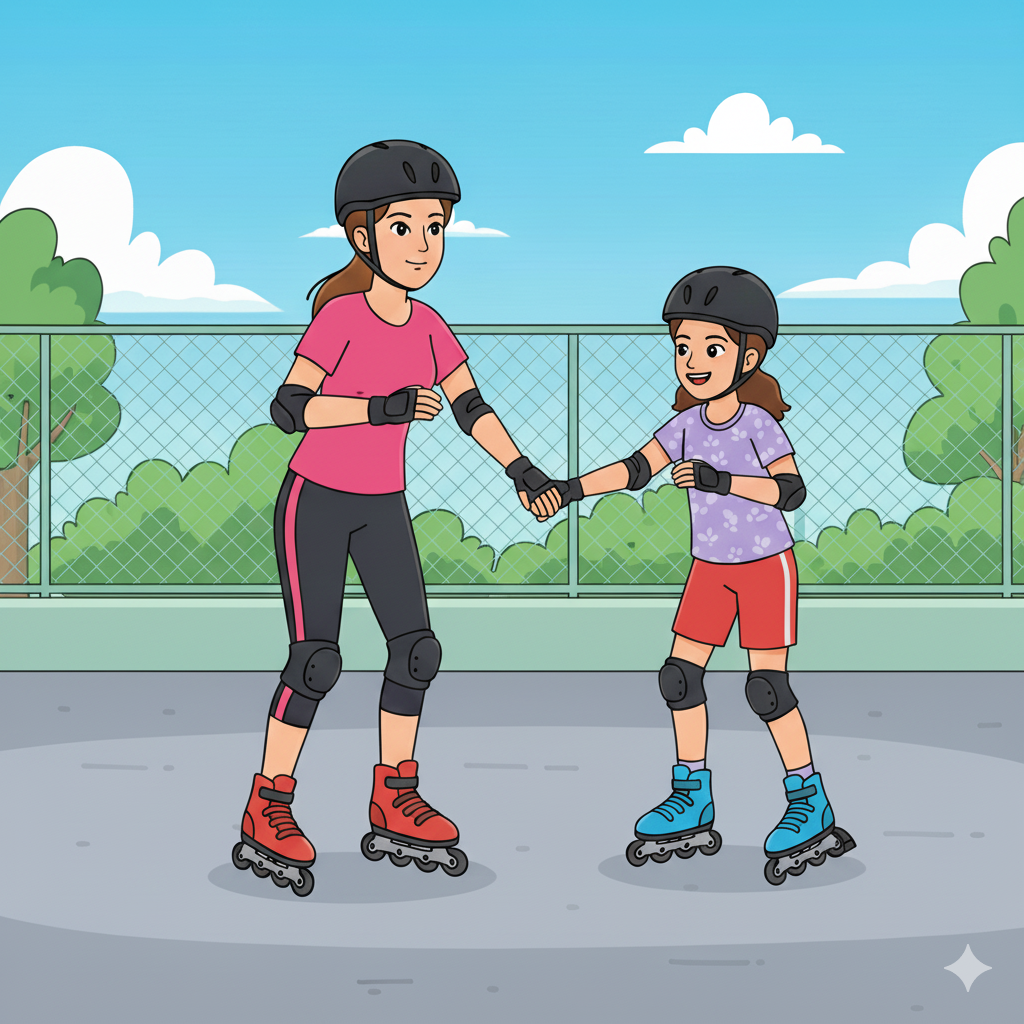
  • The Setup: Have students stand on skates next to a wall, fence, or partner, holding on lightly.

  • The Drill (Standing Still): Coach says, "Show me the Statue!" The students bend their knees and lean slightly forward.

  • The Controlled Fall: The coach now says, "Safe Fall!" They practice kneeling down onto their knee pads (first) and then placing their hands/wrist guards (second) on the ground in front of them. They practice doing this until it's automatic. This teaches the body's natural "catch" mechanism to go forward.

B. Standing Up Drill

  • The Challenge: Getting up is often the hardest part for newbies.

  • The Technique: Get them onto one knee (like a marriage proposal). Then, place both hands on the other knee, push off the ground, and smoothly roll up to the Statue Stance without standing straight up.

🛼 Intro to Inline Skating: Your First Glide!

Ready to roll? This one-time, 50-minute introductory session is where every great inline skating journey begins. We'll fast-track you from "Huh?" to "Whee!"

🛼 What You'll Master (The FUN-damentals):

  • Gear Up: Essential knowledge on the 5 key items (skates, helmet, knee, elbow, and wrist protection) and how to use them correctly. Safety first, folks!

  • Balance & Safety: Learn to find your center, master those crucial break-falls, and get the essential safety knowledge to skate with confidence.

  • The Power Stance (Knees Bend): We'll tackle the beginner's curse—straight legs! Learn to bend your knees, lean forward, and keep a low posture to secure your balance and prevent those easy backward tumbles. Focus on the bend; your knees are your secret weapon.

  • Weight Shift: Once you find your balance point (centre of gravity), we teach you the rhythm of the roll: how to continuously and effectively transfer your weight from left leg to right leg and vice versa. Remember to keep those knees bent!

  • The First Move (Basic Stride): Get rolling with your basic stride—the foundation for all future skate wizardry.

    • V-Walks: You'll start with the V-stance, performing a series of side-to-side weight shifts we call 'V-walks' (think little penguins getting their momentum!).

    • The Glide: After your V-walks, you'll set your feet into the parallel No. 11 stance. This is the magical cruise moment—gliding freely as if you've entered a space without gravity.

The Logistics (The Not-So-Fun-But-Necessary Stuff):

  • Duration: 50 minutes of focused fun.

  • Fee: $40 per person.

    • Need Gear? Rental service is available for the first session only: +$10 per person.

    • COVID-19 Note: We strongly recommend you bring your own equipment for safety, but our rental gear is available for this introductory class before you join a regular Group session.

  • What to Bring:

    • Sports attire (something you can move in, not your Sunday best).

    • Water bottle/drinking water (you'll earn it!).

What's Next?

After this session, we'll chat about your progress and figure out the perfect regular group schedule for you to keep the good times (and good form) rolling.

Keen to sign up and get your first glide on? Let us know!

Regards, Roller Cookie Club

"Happy New Year’s Eve, everyone! 🎉

​"Happy New Year’s Eve, everyone! 🎉

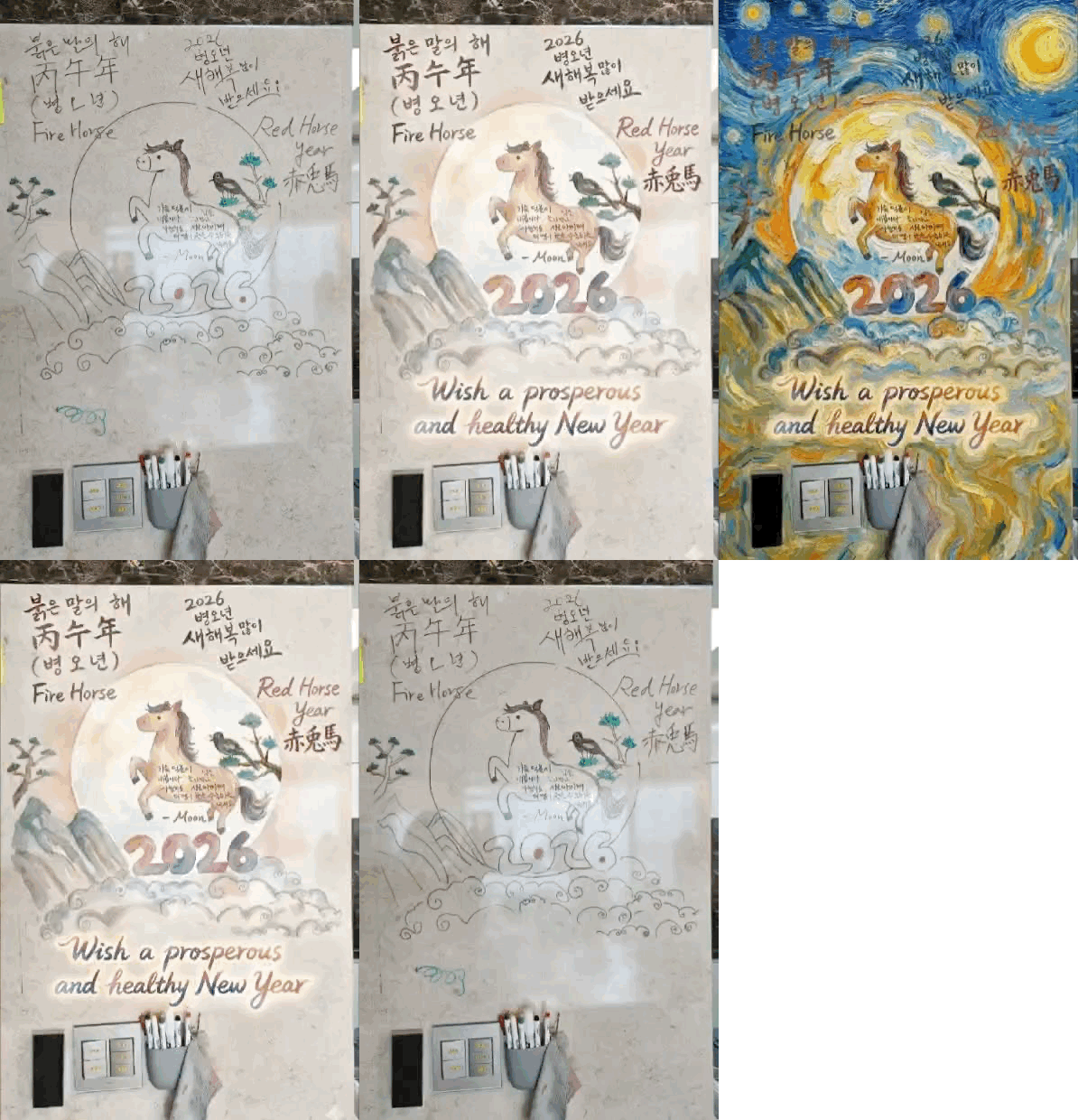
As we wrap up 2025, I wanted to share this lovely greeting for the upcoming Year of the Red Horse (丙午年). I drew the artwork with my younger child and then converted it into this video using AI. 🐎🤖

Wishing you all a powerful and energetic start to 2026. May the new year bring you and your families health and happiness! 🐎🔥✨"

Coach Moon

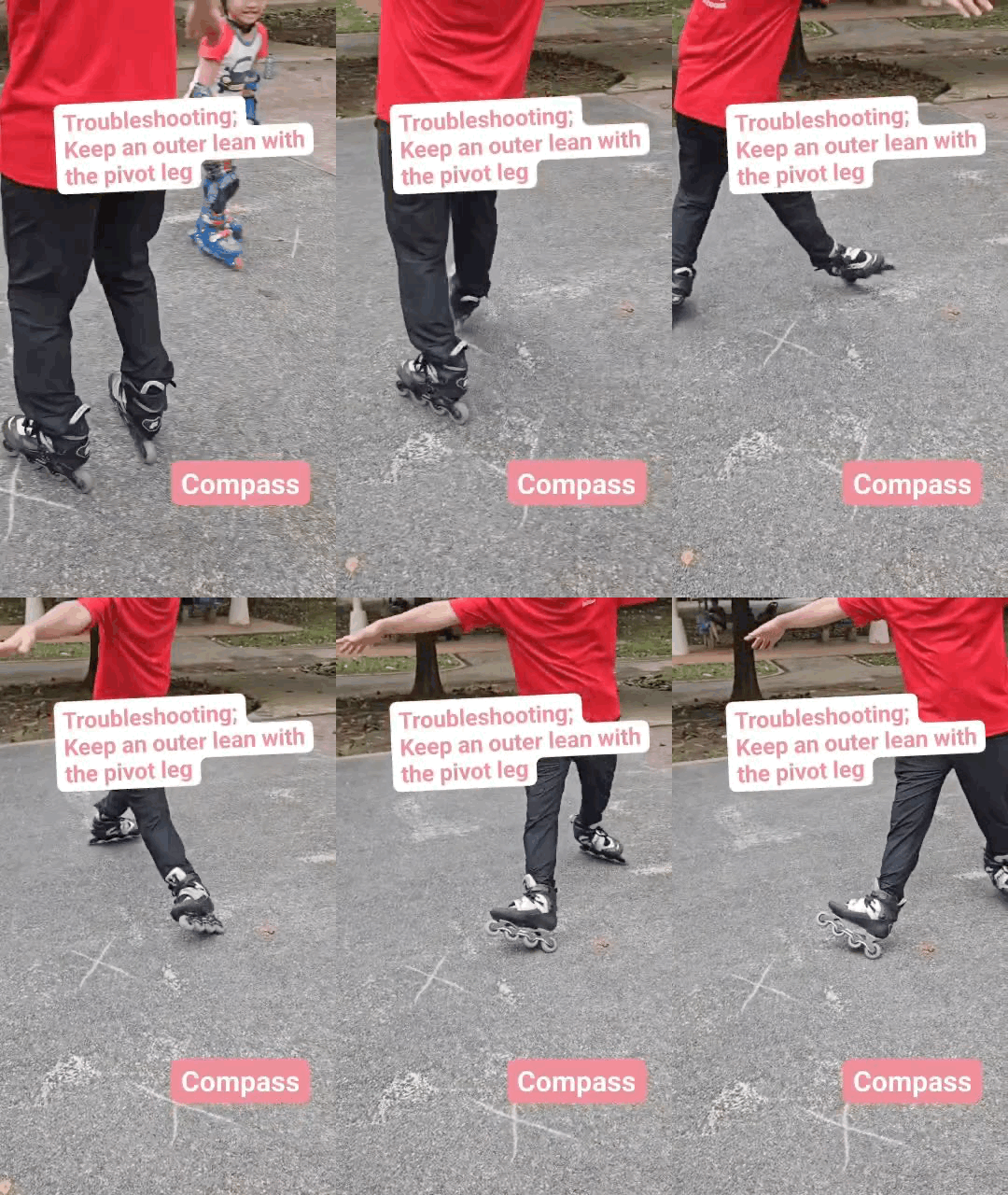
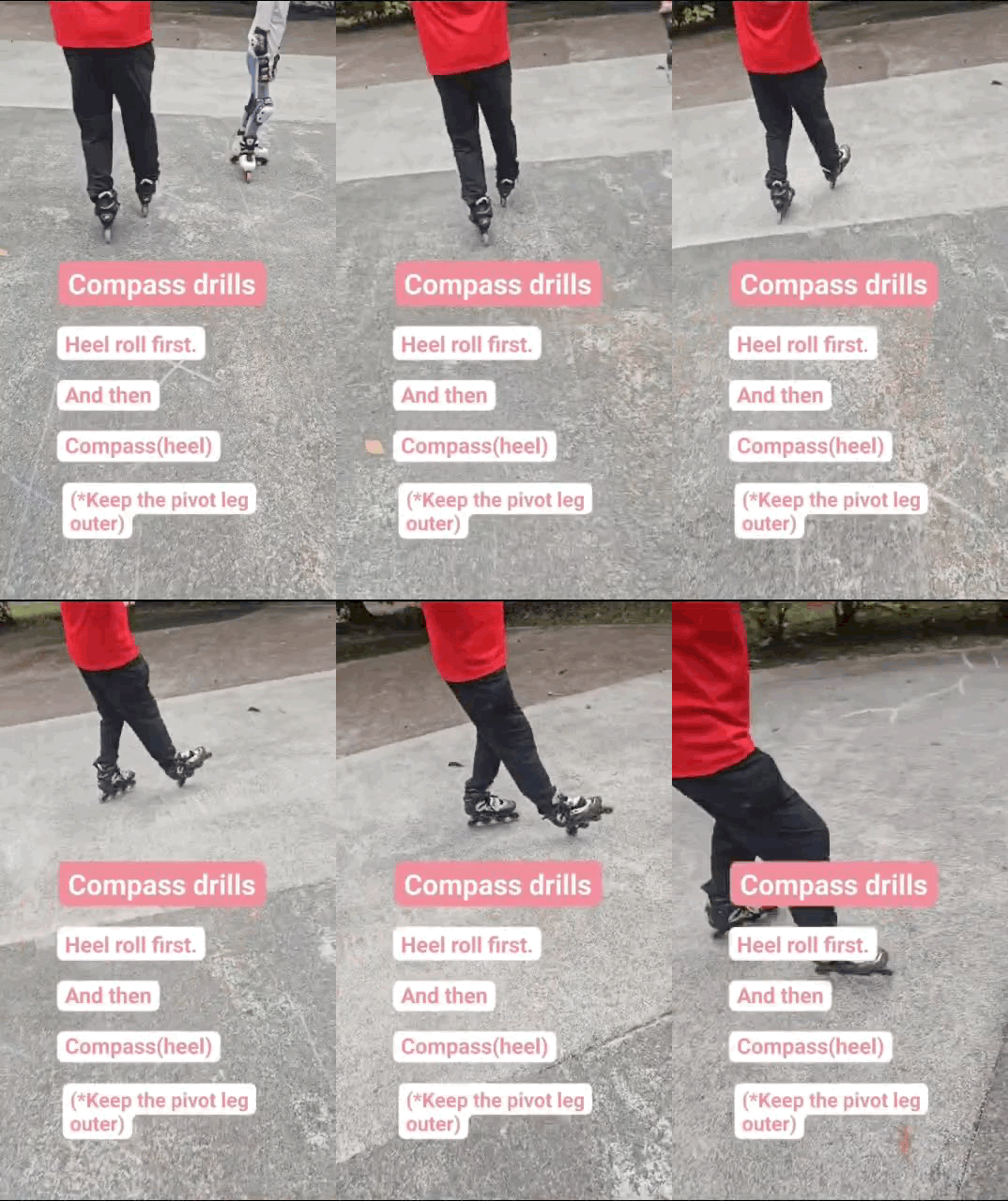
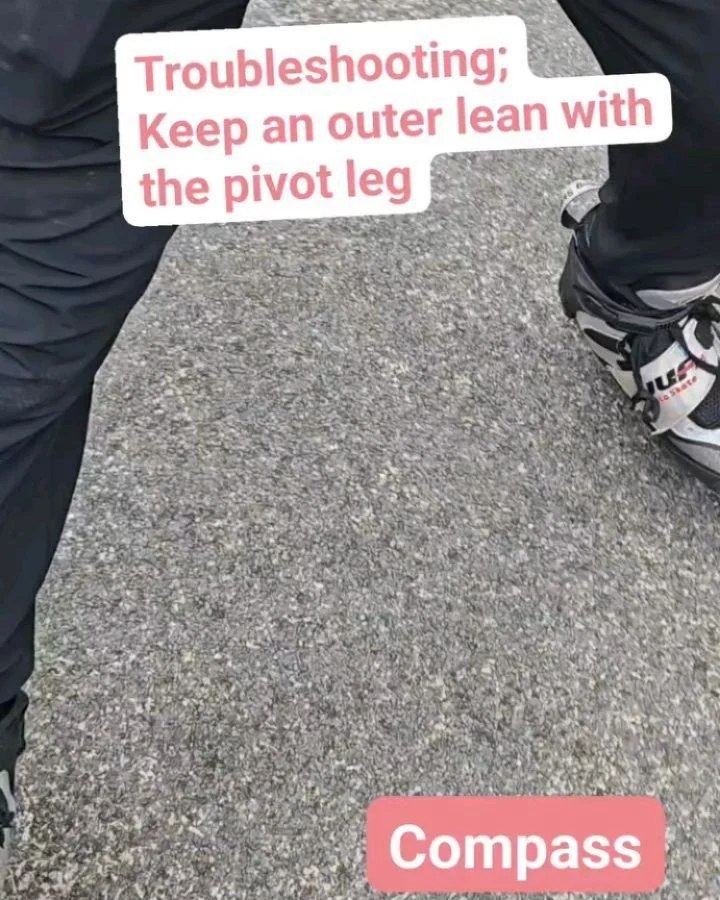
Compass (*heel)

Performing the Compass Heel Skill

The compass heel is a graceful and challenging maneuver in figure skating that involves executing a series of deep edges.

To successfully perform this skill, proper technique and body positioning are crucial.

Key Considerations:
* Pivot Leg Position:
* The position of your pivot leg is paramount.
* Outer Lean: Maintaining an outer lean with your pivot leg is essential. This outward lean helps maintain the circular momentum and allows for smooth transitions between edges.
* Inner Lean: If your pivot leg leans inward, it disrupts the circular motion, making it difficult to control the flow of the skill and increase the risk of falling.


* Body Posture:
* Upright Posture: Maintain an upright and balanced posture throughout the execution. Avoid leaning excessively forward or backward, as this can throw off your balance and hinder smooth transitions.
* Core Engagement: Engage your core muscles to provide stability and control. A strong core will help you maintain balance and execute the precise movements required for the compass heel.


* Edge Control:
* Deep Edges: The compass heel relies on deep edges to achieve its characteristic arc. Focus on digging deep into the ice with each edge change to maintain control and create a strong, defined path.
* Smooth Transitions: Practice smooth and seamless transitions between edges. Avoid abrupt changes in direction or jerky movements, as this can disrupt the flow and rhythm of the skill.


* Momentum and Flow:
* Maintain Momentum: Generate and maintain consistent forward momentum throughout the skill. This momentum will help you navigate the curves and maintain control.
* Flowing Motion: Focus on creating a flowing and continuous motion, avoiding any pauses or hesitations that can disrupt the rhythm and grace of the skill.

* Practice and Refinement:
Consistent practice and refinement are key to mastering the compass heel. Start with basic drills and gradually increase the complexity of the skill. Focus on proper technique and strive for smooth, controlled movements.

By understanding and applying these key principles, skaters can develop the skills and confidence needed to execute the compass heel with grace and precision.

🥳Celebrating a Year of Skating Success! 🥳

Dear Members and Families,

As we approach the end of another year, we at 'Roller Cookie Club' want to express our deepest gratitude for your continued support and the incredible dedication shown by our skaters.

This year has been a remarkable journey, filled with exciting achievements:

* Skater Development: We've witnessed impressive progress every weekend at West Coast Park, with many members mastering new skills and exceeding their personal goals; 6 times of the evaluation.

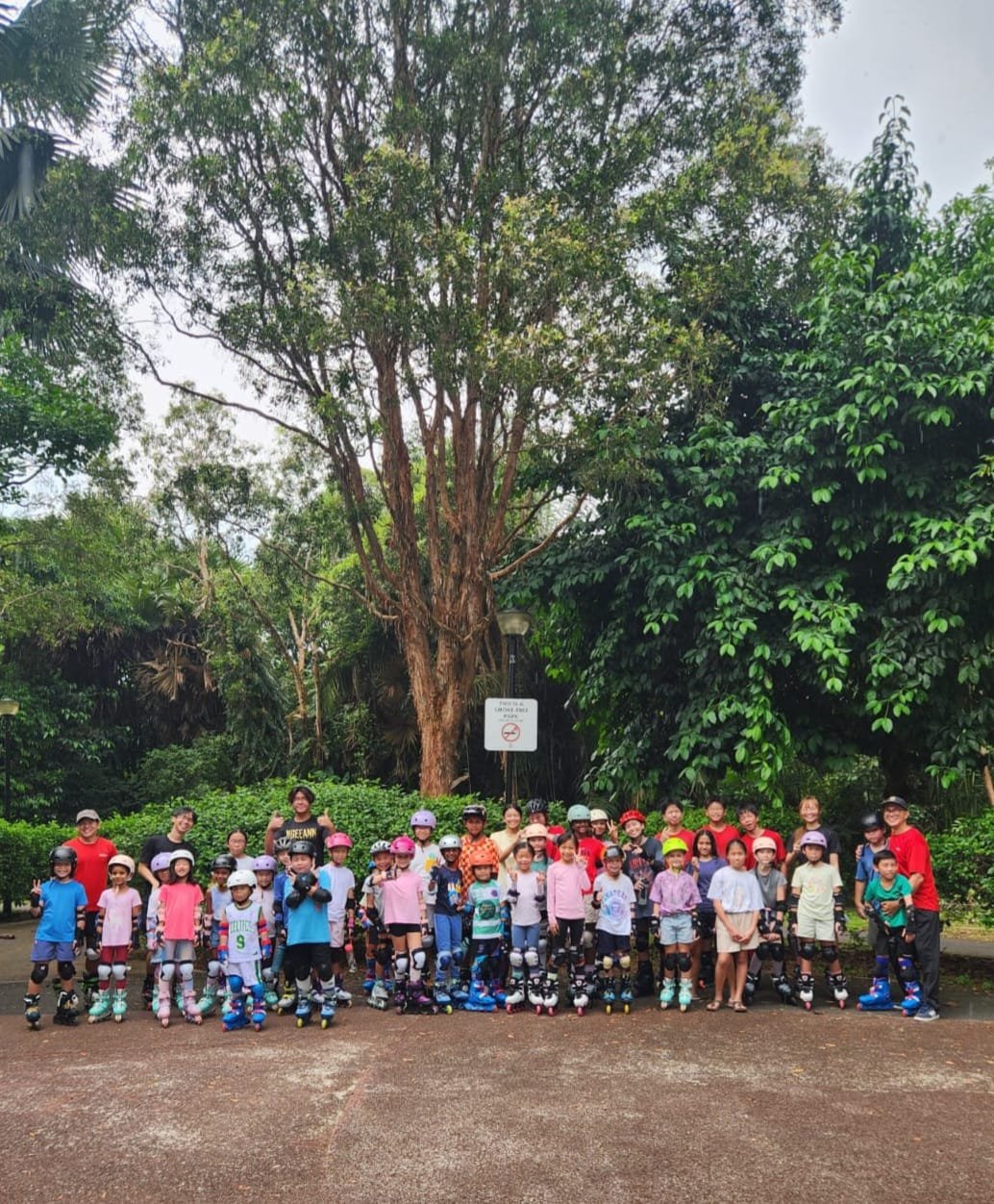
* Community Growth: Our club has flourished into a vibrant and supportive community, fostering lasting friendships and creating unforgettable memories both on and off the West Coast Park.

* Family Involvement: We sincerely appreciate the unwavering support from our families during the Year-end skaring festival.

Your encouragement and dedication are invaluable to the success of our skaters and the club as a whole.

We are incredibly proud of each and every member, and we are excited to see what the new year will bring.

We look forward to continued growth, new challenges, and many more opportunities to celebrate the joy of inlineskating together.

Wishing you and your families a joyous holiday season filled with laughter, love, and perhaps a few exhilarating skating sessions!

Happy Holidays and a Prosperous New Year!

Regards,

Coach Moon, Head of coaches.

24 December 2024

Why ‘Eagle’?

Can you skate forward and backward, right? Great job!
Now, you may like to ask what's next? I strongly recommend to learn 'Eagle'.


What is ‘Eagle’?
Spread out legs like giant wings and swing it like wave. ‘Eagle’ is difficult to achieve but it should be your killer skating skills. I remembered it took around 1 year to master Eagle because I was lack in hip's flexibility. I tried many kinds of stretching like yoga.

Eagle stance; dray-land training without skates

▶️ Video clips: Eagle Glide, Eagle Turn inside, Eagle turn outside

To enhance your Eagle skill, you have to build a plié position first.

A plié is a fundamental ballet position that involves bending the knees while keeping the legs turned out and the knees open over the toes. * The French term plié means "creased" or "folded".

Tips: Start by bending your knees just slightly, keeping your upper body straight with your shoulders down. Keep your heels planted. Stop bending your knees when they extend just over your toes. (wikihow)


✅ Eagle variation: Eagle glide-> Eagle Turn-> Eagle Snake->Eagle Cross /*reverse eagle(swan)


▶️ plié position exercise; Watch this video


▶️ Another exercise with the bar, watch it


https://pbt.org

Extra tips!

This ankle exercise routine is designed to strengthen and improve control of the muscles surrounding your ankle joint.

https://youtu.be/RIRXb_HJIZw?si=c9BxPmAjSDviCqLU

Some say that pliés are one of the first things a ballet dancer learns, but they are the last thing they master.

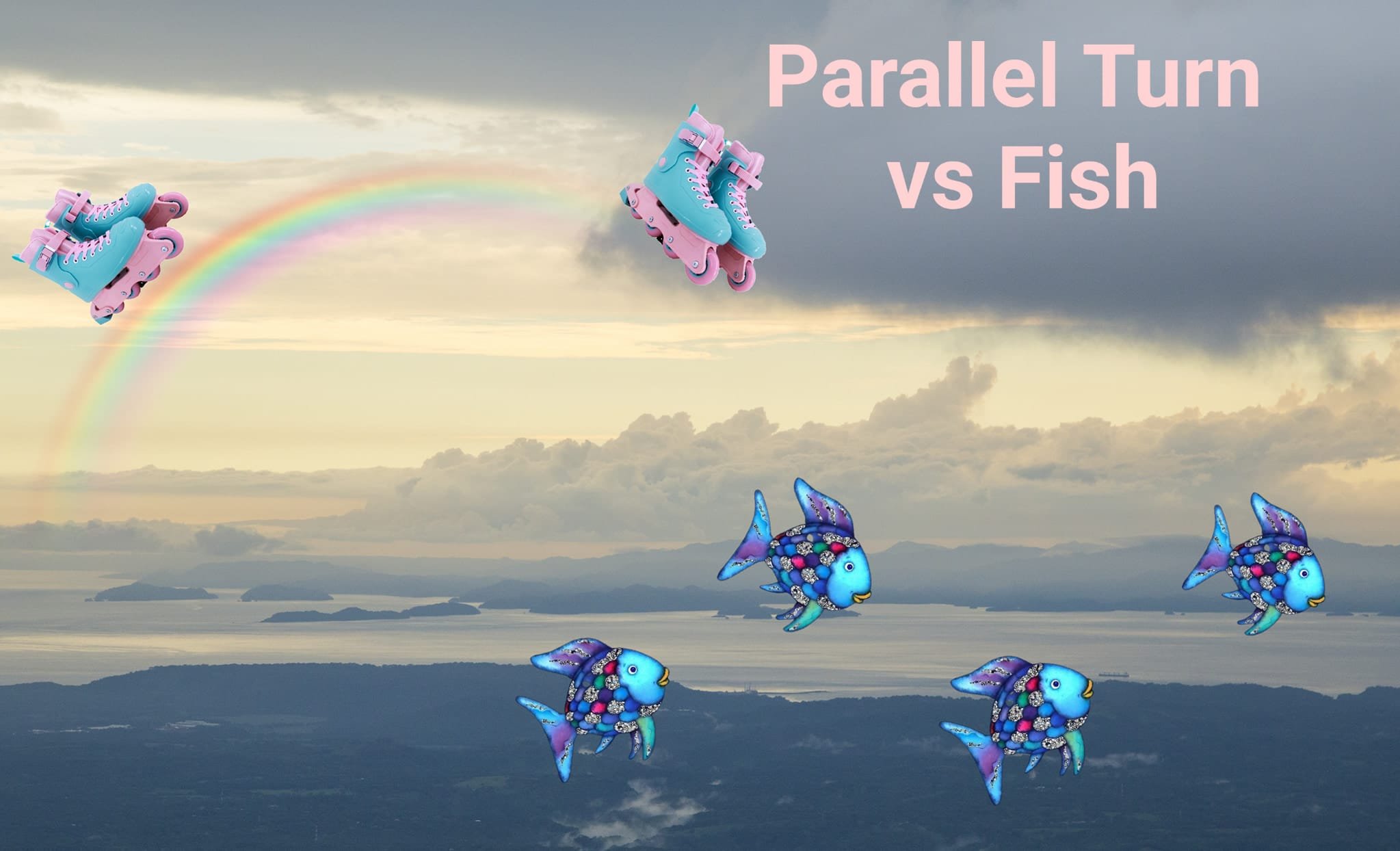
Storytelling for kids [ Parallel Turn and Fish]

Lily loved skating! She watched Parallel Turn glide like a rainbow on wheels, but she wanted to be speedy like a fish!

"Can I be a wiggly fish too?" she asked her teacher.

The teacher smiled. "Of course! Fish keeps his heels down and wiggles side to side, like dodging seaweed!"

Lily giggled. She wobbled at first, but soon she was zooming between cones, a happy fish in the big blue rink!

So next time you skate, remember: Parallel Turn makes big circles, Fish wiggles fast! Both make you a super skater!

coach Moon, RCC

you may like to know this full story below?

Once upon a time, in a land filled with smooth skating rinks, lived two skating moves: Parallel Turn and Fish.

Parallel Turn was a graceful giant. He loved gliding in big, smooth circles, like a rainbow on wheels. He'd bend his knees and lean a bit in, just like you do when you go around a corner on your scooter.

Fish, on the other hand, was a tiny speedster! He zipped around cones in quick, short turns, like a playful fish dodging seaweed in the ocean. He kept his heels down and wiggled his feet from side to side, making a fun little wiggle dance.

They were both fun to do, but very different! Parallel Turn was all about smooth curves, while Fish was all about quick zigzags.

One sunny day, a little skater named Lily came to the rink. She loved watching Parallel Turn glide gracefully, but she also wanted to be as fast as Fish!

"Can I learn Fish too?" she asked her skating teacher.

"Of course!" smiled the teacher. "Just remember, Fish likes to keep his heels down and wiggle his feet side to side. Imagine you're a little fish dodging seaweed!"

Lily practiced for a while, giggling as she wobbled and wiggled. Soon, she was zooming between cones, feeling like a happy little fish in the big blue rink!

So next time you're at the rink, remember: Parallel Turn is for smooth, graceful circles, while Fish is for quick, fun wiggles! They both help you become a super skater!

coach Moon, RCC

Fish vs Parallel turn

Fish: Mastering Slalom Maneuvers

This article dives into the world of slalom skating, exploring the technique of the "Fish" and how it compares to the "parallel turn," a fundamental skill for general skating. While the Fish is all about agility in slalom, the parallel turn provides a smooth turning technique for recreational skating or navigating obstacles. No doubt both involve turning, they serve distinct purposes on the skating rink or at West Coast Park.

1. Parallel Turn: A Versatile Turning Technique

The parallel turn is a foundational turning skill in skating, not specific to slalom. It allows for smooth, controlled turns, making it ideal for general skating or maneuvering around obstacles. Imagine a pair of scissors – that's the basic stance. Your feet tilt slightly inwards or outwards depending on the turn. Your edges correspond to the turning direction, and your body leans inwards or outwards for stability. Most of your weight (around 70%) rests on the front leg, guiding the turn.

2. The Fish: Zigzagging with Finesse

The Fish, on the other hand, belongs to the realm of slalom skills. It's a series of quick, short turns designed to navigate between closely spaced cones. Unlike the parallel turn, the Fish involves a zigzag motion between cones placed upright. Here's what sets it apart:

- Stance and Edge: The Fish employs a "number 11" stance. Imagine your feet like train tracks! While a parallel turn uses more corresponding edges; angled outwards & inwards, Fish uses your center edge for maneuverability, lesser corresponding edge..
- Footwork: The key to the Fish lies in heel pivoting. Imagine your feet as hinges, with the movement originating from your heels.
- Weight Distribution: Unlike the parallel turn, the Fish requires you to keep your weight on your heels throughout the maneuver.


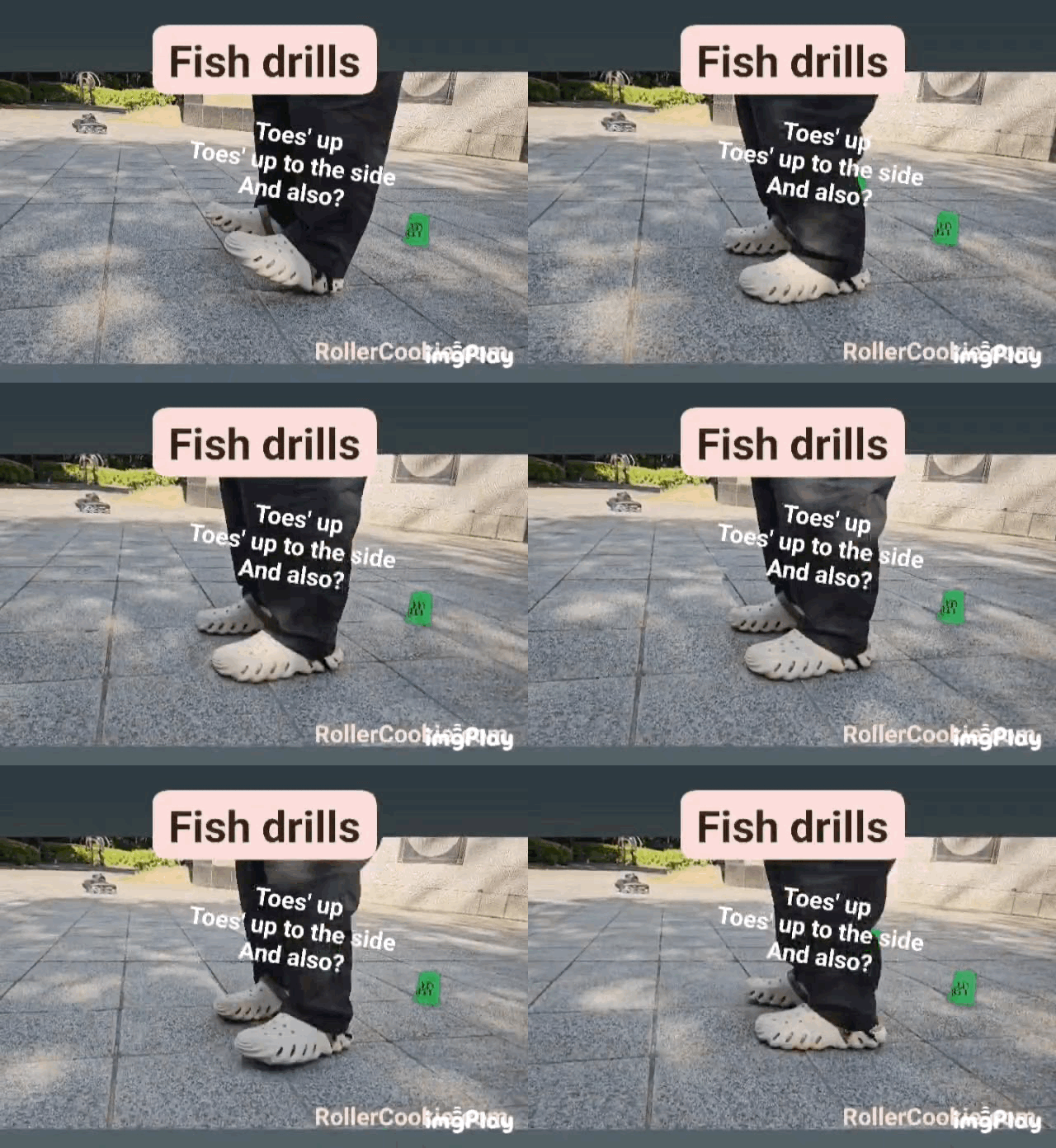
2-1 Mastering the Fish: Key Techniques
Conquering the Fish requires mastering three key elements:

- Toe Up: Shift your weight to your heels, then lift your toes.
- Toe Up to the Side: Maintain your heel pivot and gently swing your foot sideways, creating the zigzag motion. Focus on keeping your ankles low and initiating the movement from your heels.
- Wiper: Keep your toes down. To refine the movement, perform a subtle ankle wiggle from side to side. Imagine you're trying to squeeze through a narrow gap while keeping your feet pointed forward.


3. Key Difference:
The main difference lies in the edge used:

Parallel Turn: Uses corresponding edges (inner/outer) for carving smooth turns.
Fish: Utilizes the center edge for quick changes in direction during slalom.

So, the next time you hit the rink, remember:

Parallel Turn: Master those smooth, graceful curves.
Fish: Become a speedy dodger and navigate cones like a champ!

Once you feel comfortable with these techniques, set up some cones and put your Fish skills to the test! With dedication and practice, you'll be navigating those cones like a pro. Keep rolling!

Happy Skating!


Watch the video_Fish drills 👈🏼 📽️


coach Moon, RCC

Spin Stop

: A Smooth Stop for Rollerbladers

What is your favorite stop skills without heel-brake?

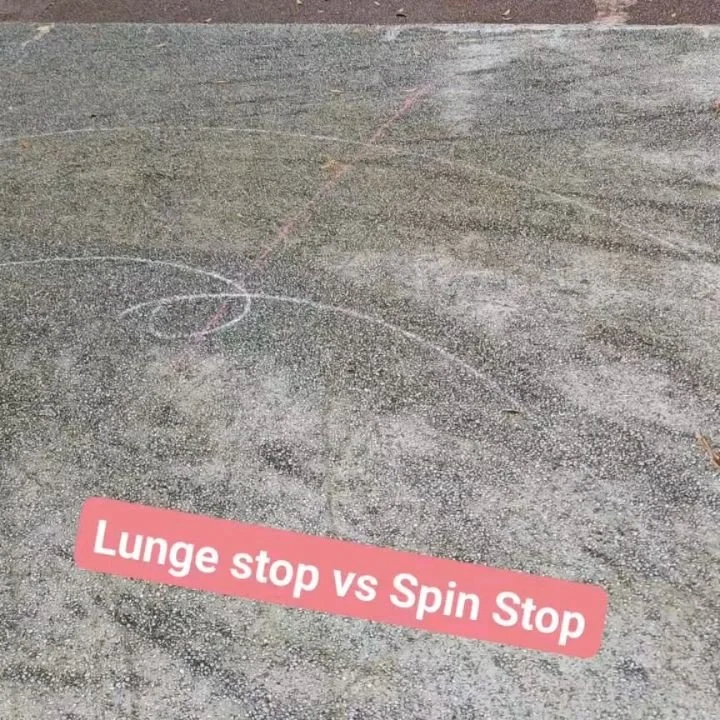
The Spin Stop is a stylish and efficient way to stop in rollerblading without relying on the heel brake. It adds a touch of flair to your skating and allows for quicker transitions when maneuvering.

Here's how to break down the Spin Stop, including drills to help you master it:

Preparation:

1. A-frame Stance with Inside Edge: Begin in a comfortable A-frame stance with your knees slightly bent. *Point the toes of your dominant leg (the leg you prefer to push with) inwards, creating an inside edge on this foot. This will be your outside leg during the spin and will provide the grip for stopping.

(*Point the toes ➡️ Some skaters like to initiate T-stop and then proceed to Spin stop)


Drills for Spin Movement:

  1. Pivot on Toe (Inside Skate): Before attempting the full spin, practice pivoting on your toes with your inside foot (the foot with the inside edge).

    • Refer to video clips [insert link to video clips on toe pivoting] for proper form. This drill helps develop balance and control for the spin.

  2. Drill for Spin Movement - A-frame and Body Rotation:

    • Maintain an A-frame stance and bend down for a deeper inside edge on your dominant leg.

    • Keep your core engaged and rotate your upper body in the direction you want to spin (typically towards the outside leg). Keep your shoulders facing the direction you're turning.

    • Practice this drill without actually completing the full spin yet. This helps isolate the upper body movement needed for the spin.


Executing the Spin Stop:

  1. Upper Body Rotary Motion: Once comfortable with the drills, initiate the full spin by initiating a rotary motion with your upper body in the desired spin direction.

  2. Apply Pressure on Outside Skate to Stop: As you rotate, apply light pressure on the balls of both feet. The inside edge of your dominant leg will provide the stopping power, while the other foot helps maintain balance. Gradually increase pressure on the outside skate (the one with the inside edge) to slow down and come to a complete stop.

Additional Tips:

  • Look where you want to go: This will help maintain your balance and guide your spin.

  • Don't force the spin: Let the rotation flow naturally with your body movement.

  • Practice pivoting: As mentioned earlier, practicing pivoting on your toes with both feet is highly beneficial for improving balance and control.


Watch the Spin Stop’s video 👈🏼 📽️

How to support your students?

Watch the video 👈🏼 📽️


Lunge Stop

▶️Lunge stop

: People used to call it hockey stop or power stop. In fact, it is one of stop skills at full speed. Look like in between Spin stop and forward powerslide, right? We like to reform it to be suitable for our students. Here we go.

*Lunge turn (tuck in and weight on your inside leg)

*Lunge Turn to A-frame turn

*Sharp turn like Snail (use shoulders to turn upper body)

*Weight Shift

*Keep upper body up to maintain balance

Watch the video_Lunge stop 👈🏼 📽️

Lunge Stop ( more drills) 👈🏼 📽️

Another video? :) 👈🏼 📽️

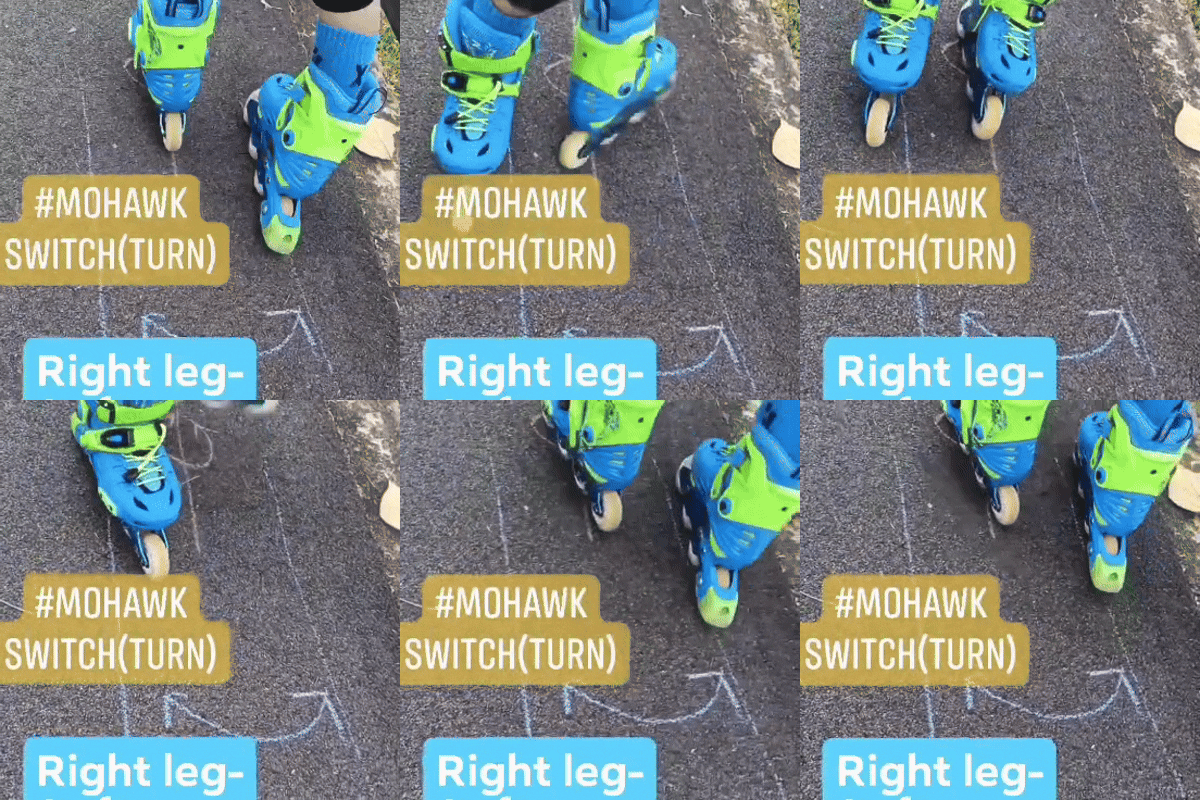
Mohawk turn

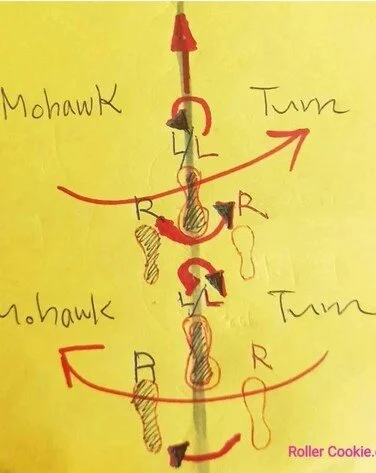
The Mohawk turn is a fundamental skill most hockey or figure skaters learn early on in their journey. It's like a magic key that unlocks smooth transitions from forwards to backwards skating without sacrificing speed. But the benefits of the Mohawk turn go far beyond maintaining momentum.

Imagine skating forwards, then with a little twist, you're zooming backwards – all while staying nice and balanced!

The Mohawk turn is like a bridge between going forwards and backwards, so it helps you practice keeping your balance on one foot while you switch from skating forwards to skating backwards (and vice versa!). The more you practice Mohawk turns, the smoother you'll become on the road! Keep rolling :)


▶️ Mohawk turn(switch) _keys

: Set the pivot leg(keep on the axis) and action leg(crossing leg)

: 45 degree first, then gradually try 90`, 130` and then 180`finally.

: Look into any difference? ; figure skating vs hockey/recreational skating


▶️ Enhancing the Benefits:

  • The Mohawk turn not only helps with maintaining momentum during direction changes, but it also improves,

    • Balance: maintaining an edge during the Mohawk turn strengthens ankle and core muscles, leading to better balance.

    • Body weight transfer: Mohawk turns help skaters learn to shift their weight from one foot to another effectively, which is crucial for jumps and spins.

    • Edge control: mastering Mohawk turns improves a skater's ability to control their edges, leading to cleaner footwork and sharper turns.

▶️ Refer to the video clips below

Watch the video_Mohawk turn 👈🏼 📽️

Mohawk turn_zigzag drills 👈🏼 📽️

Mohawk turn _ 90` 👈🏼 📽️

Mohawk turn_180` 👈🏼 📽️


Parallel Turn; Conquer Turns Like a Pro

Mastering the Parallel turn

Many skaters find the parallel turn tricky at first. It's true, it requires more agility than the A-frame turn, but don't let that scare you away! Think of it like riding a bike – you need to lean into the turn to make it smoothly.

Here's the good news: mastering the parallel turn gives you amazing benefits, especially at higher speeds. You'll have better control and feel less stressed on steeper slopes.


Learning Curve Made Easy

If you're already comfortable with the stem turn, you can smoothly transition to the parallel turn by starting slow and gradually increasing your speed. There are also drills you can practice to improve your technique.


▶️ The Secret Sauce: 3 Key Elements

There are three key components to mastering the parallel turn:

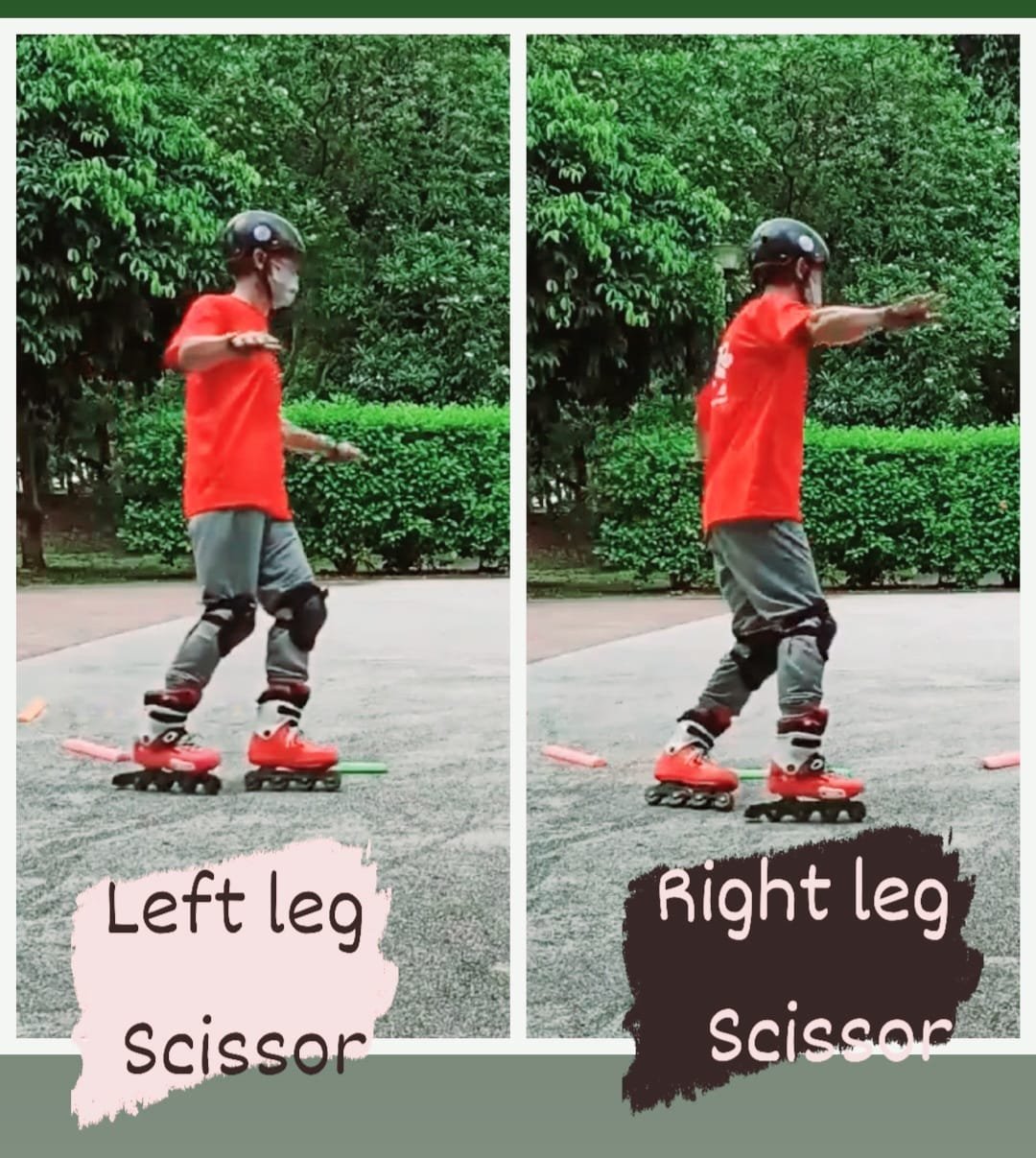
  1. Scissors Stance: When turning right, place your right leg in front (opposite for left turns). This creates a scissor-like position.

  2. Edge Work: Lean your body slightly inward, towards the center of the turn, to engage your edges for better grip.

  3. Upper Body Rotation: Rotate your upper body in the direction of the turn, adding control and stability.


Need a Different Perspective?

If the right-leg-forward stance feels awkward, try the opposite! Some skaters find a left-leg-forward stance more comfortable for right turns.

Watch the video_ 👉🏻 📽️ Opposite Scissor stance

Another Video 👉🏻 📽️


Practice Makes Perfect

Remember, practice makes perfect! Start on a gentle slope and gradually increase the difficulty as you get comfortable. Refer to the provided tips to enhance your performance and become a confident parallel turn pro!.


Keep Rolling,

coach Moon

Stem Turn

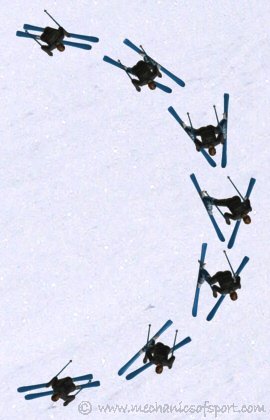
Originally, Stem turn is one of skiing terms

* Turn skills in our curriculum: Step turn -> Stem Turn -> Parallel turn -> Lunge turn / *Backward turning.

Stem turn is the bridge skill in between A frame turn and parallel turn

▶️ 3Key drills

1. A-frame turn

2. Inside leg goes to outside leg (crosses over the axis)

3. 11 or scissors rolling

Video clips 👉🏻📽️ Watch it

Master the Grass Stop

Your Downhill Emergency Brake

The Grass Stop is a crucial skill for skaters, especially when tackling downhill slopes. If you find yourself going too fast or encounter a steeper incline than anticipated, the Grass Stop can be your emergency braking technique.

This maneuver requires good control over your upper body posture and weight transfer. Be prepared for a surge of inertia as you enter the grass due to the increased friction.

Why Beginners Should Learn It:

Before hitting those park connectors, mastering the Grass Stop is essential. It equips you with the confidence and ability to handle unexpected situations when cruising downhill.

Grass Stop_Key drills

#Wider(longer) scissors stance

#Upper body lean backward

#Weight on following(rear) leg

Video clips

Watch the Grass stop 👉🏻 📽️ Video 1

Do you know how much our students love it? 👉🏻 📽️ Look at this video

*Refer to below the videos, how another skaters use it

👉🏻 📽️ Grass stop video 2

👉🏻 📽️Grass stop video 3

Keep Rolling,

Coach Moon


Story for the little shredders :)


Whoa Nelly! Grass Stop to the Rescue!

Going downhill on your scooter is super fun, but what if you get a little too speedy? Don't worry, the Grass Stop is your secret weapon!

Imagine your scooter is like a zooming rocket, but sometimes the hills get steeper than expected. The Grass Stop is like a special trick to slow down safely when things get a bit fast.

Here's how it works: keep your body nice and tall, just like a superhero! Then, gently lean your weight back a little and steer your scooter towards a grassy patch. The grass acts like a big, soft friend that will help you slow down nice and easy. Remember, the grass will feel different than the smooth ground, so hold on tight!

Why is the Grass Stop so cool? It lets you be a safe scooter adventurer! Before you zoom around the park, practicing your Grass Stop on a small grassy hill is a great idea. That way, you'll be ready for anything!